

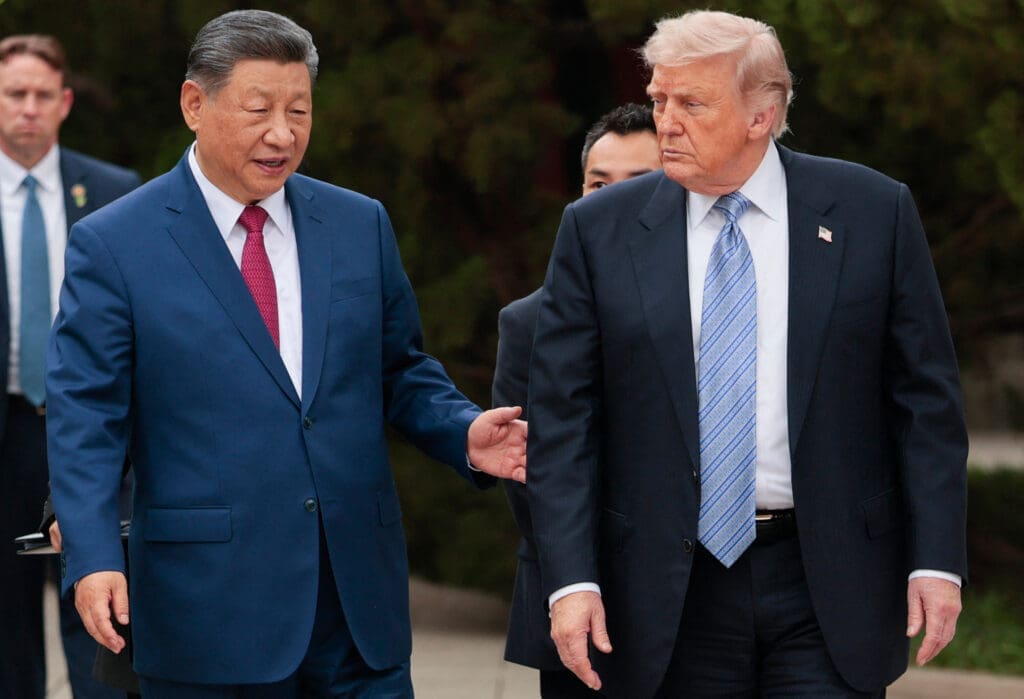
When Beijing rolled out the red carpet for U.S. President Donald Trump in May, 2026, it was more than an exercise in protocol. It was a symbolic attempt to mend a fractured global order. Trump’s visit followed a significant decline in the U.S. trade deficit with China to just over $202 billion in 2025 — a 31.6% decrease from the previous year. This gave him grounds to claim that his policy of pressure on Beijing had been successful, paving the way for negotiations on a second major trade deal.
Yet the clouds of a new Cold War hung over Trump’s summit with his host, President Xi Jinping, reflecting a tense relationship at a historic crossroads. While the meeting revived personal diplomacy between the two leaders, its timing reflected not only a desire for de-escalation, but also a realization that the open confrontation between the world’s two largest economies had become unsustainably costly. This in turn raises a deeper question: Did the visit mark the beginning of a strategic settlement, or merely a temporary respite in an existential struggle?
From Trade War to Managed Competition
Since the 2018 outbreak of trade war between the U.S. and China with rounds of tit-for-tat tariffs during Trump’s first term, their relations have undergone a dramatic change — from a dispute over their balance of trade into a comprehensive technological war over semiconductors, artificial intelligence and supply chains. The Xi-Trump summit indicated a shift in US strategy, from open confrontation toward a relationship of “managed rivalry” through tangible institutional mechanisms.
Trump also invited Xi to visit the White House, reflecting a desire to establish guardrails aimed at preventing the economic and technological competition from escalating into an unplanned military confrontation, as well as to return to the language of mutual interests as dictated by the interconnectedness of the global economy. The most significant achievement of the summit was an agreement to establish a bilateral trade council tasked with identifying non-security-sensitive sectors, with a view to reaching reciprocal trade commitments and avoiding worst-case scenarios.
Contrary to the rhetoric of a complete break that could lead to unforeseen chaos, the World Trade Organization data and World Bank projections show that U.S.-Chinese ties continue to be dominated by mutual dependence. Despite the tariff war, total trade in goods and services between the two countries grew to an estimated $658.9 billion in 2024, reflecting the resilience of their commercial ties. The data also indicates that supply chains have not disappeared, but rather evolved. The American trade deficit with Southeast Asian countries has grown by $43 billion in the technology sector, meaning that Chinese components are still reaching the U.S. in great quantities, via third parties. In his effort to win gains from his meeting with Xi, Trump sought to secure Chinese commitments to purchase Boeing aircraft and large quantities of liquefied natural gas and soybeans, a potential boost to his electoral base before the midterm elections in November.
Yet the biggest surprise of the summit concerned computing power and AI: Washington officially approved conditional export licenses for U.S. firm Nvidia’s advanced H.200 chips destined for 10 major Chinese companies (including giants Lenovo and Foxconn), limited to 75,000 chips per company and in quantities not exceeding 50% of those supplied to the American market, according to Reuters. However, those shipments have completely stalled; at the time of writing, not a single processor had been delivered.
This impasse results from the Chinese central government’s refusal to approve the deal. Beijing is pressuring its domestic companies to rely more on products made at home — such as Huawei’s processors or chips made by emerging AI companies like DeepSeek—in order to bolster the country’s self-sufficiency and reduce its dependence on the West. This sensitive deadlock prompted Nvidia CEO Jensen Huang to join the Trump delegation in Beijing at the last minute in search of a breakthrough.
Were the sales to come to fruition, Washington would want to see the resulting profits channeled into funding domestic innovation, as it seeks to maintain its global lead in the most advanced technologies. Yet Huawei has achieved a major leap forward with its Ascend 910C processor, capable of 80% of the performance of Nvidia chips, positioning Beijing as an ambitious competitor rather than a dependent consumer.
Taiwan and Other Red Lines
The question of Taiwan remains the central point of contention and the true test of stability in Sino-American relations. During the summit, China’s warnings were clear and firm: Taiwan is a non-negotiable red line. China views Taiwan as its own territory and a historical priority that cannot be postponed; Washington continues to use the issue as a strategic deterrent.
Both sides are undoubtedly aware of the limited likelihood of war over the island. Beijing is currently not prepared to sacrifice its economic growth for a military adventure, and Washington knows that any clash over Taiwan would bring about the total collapse of the global trading system. That said, Washington approved an $11 billion arms package for Taiwan in late 2025. Analysts have suggested that Trump is using military aid as a bargaining chip in trade negotiations, hinting that it could be scaled down in exchange for Chinese economic concessions. Indeed, Trump himself publicly suggested, both before and during his talks with Xi, that the timing and size of the military package could be up for discussion in exchange for tangible economic and trade concessions from Beijing.
This pragmatic, deal-based approach has worried Washington’s traditional Pacific allies. Yet for now, it has kept the question of Taiwan within the framework of traditional American “strategic ambiguity,” and direct hotlines have been activated to prevent a military clash in the Taiwan Strait or the South China Sea.
One of the key factors reshaping U.S.-Chinese relations in 2026 is the emergence of the Middle East as a central variable. Trump and Xi met in the shadow of acute tensions in the region, and the crisis around the closure of the Strait of Hormuz and the U.S. war with Iran were firmly on their agenda. The U.S. needs China to pressure Tehran to ensure the flow of oil exports through the Strait; for its part, Beijing recognizes that its growing influence in the Gulf grants it a key role in the region’s security. It leveraged this at the summit to secure a relative easing of restrictions on its investments in the green energy sector in the U.S. Yet the reality is that their interests, by necessity, converge: both sides share the desire to secure energy routes and ensure the stability of maritime navigation. Their cooperation here represents a model of an uneasy partnership, whereby adversaries coordinate on specific issues to serve their shared national security interests.
Ultimately, the Xi-Trump summit aimed less at resolving their structural conflict than at institutionalizing their rivalry. This presents us with a kind of intelligent cold war, in which the two adversaries compete militarily and technologically yet maintain trade relations to avoid a shared collapse. The balance of power between Washington and Beijing in 2026 no longer allows either side to impose a complete defeat on the other without risking economic or military suicide.
This has produced what might be termed a cautious strategic settlement — a state of cold peace based not on trust, but on a shared destiny in the face of potential catastrophes. Herein lies the essence of the transformation in contemporary international relations; a shift away from attempts to achieve a decisive victory, in favor of efforts to manage deadlock.
Trump, with his commercial pragmatism, and Xi, with his historical vision, have both realized that the superpower status in the 21st century no longer denotes the ability to eliminate an adversary. Rather, it implies the ability to contain and manage the pace of conflict. Victory is measured not by the ability to win wars, but to prevent them. Today, eliminating a rival would rip apart global supply chains, collapse the financial markets, and tip the world into a dark tunnel of recession from which nobody would emerge unscathed.
Accordingly, the Xi-Trump summit did not end the U.S.-China rivalry, but rather shifted it from the boxing ring to the chessboard — one laid with mines. To navigate it, both leaders must move cautiously, first exchanging blows over technology, then shaking hands to secure energy corridors. This kind of shrewd conflict management helps distance them from the prospect of a devastating military clash, but turns their struggle into a protracted contest of endurance. The stakes are not who fires the first shot, but who has the greater stamina, the ability to maintain domestic stability and technological superiority, without descending into total chaos. In this sense, the summit between Trump and Xi can be seen as an insurance policy against total collapse.